M&A due diligence review in monday.com
Legal due diligence is the same twenty questions asked of every contract in the data room. That is a table, and it should be reviewed as one. Doclayer turns the contracts attached to your deal board into rows, your diligence checklist into columns, and fills each cell with a cited answer that a lawyer can verify in one click.
How the deal board is set up
Most deal teams already run a monday board per transaction, with a group of items for the data room index and the files attached to those items. Doclayer works from that board. Add the Matrix view, pick the contracts to review, and the team keeps working where the deal already lives. Counsel, the deal lead and the client can all open the same table; a monday Viewer sees the answers and the evidence but cannot change anything.
A starting column set for commercial contracts
These eight columns cover what a buyer usually needs from a customer or supplier agreement in a share purchase. Add, remove or reword them for the deal; a review takes up to 15 Questions.
| Question (column) | What a good cell holds | Usual decision |
|---|---|---|
| Does a change of control of the target require consent or trigger a termination right? | The clause, quoted, with the page. Whether consent is needed, from whom, and the notice period. | Issue when consent is required from a material counterparty. |
| Can the agreement be assigned without consent? | Assignment clause with any carve-outs for affiliates or successors. | Question when the carve-out is ambiguous. |
| What is the current term, and how does it renew or expire? | Start date, initial term, renewal mechanism, and the next notice deadline. | Clear, unless a renewal deadline falls before closing. |
| What termination rights does the counterparty have, and on what notice? | Termination for convenience, for cause, and on insolvency, each with its notice period. | Issue for short-notice termination for convenience on a key contract. |
| Is there exclusivity, non-compete, or a most-favoured-customer clause? | The restriction, its scope, territory and duration. | Issue when the restriction would bind the buyer group. |
| What is the cap on liability, and what is excluded from it? | Cap amount or formula, and the list of uncapped heads of loss. | Question when the cap is below the contract's annual value. |
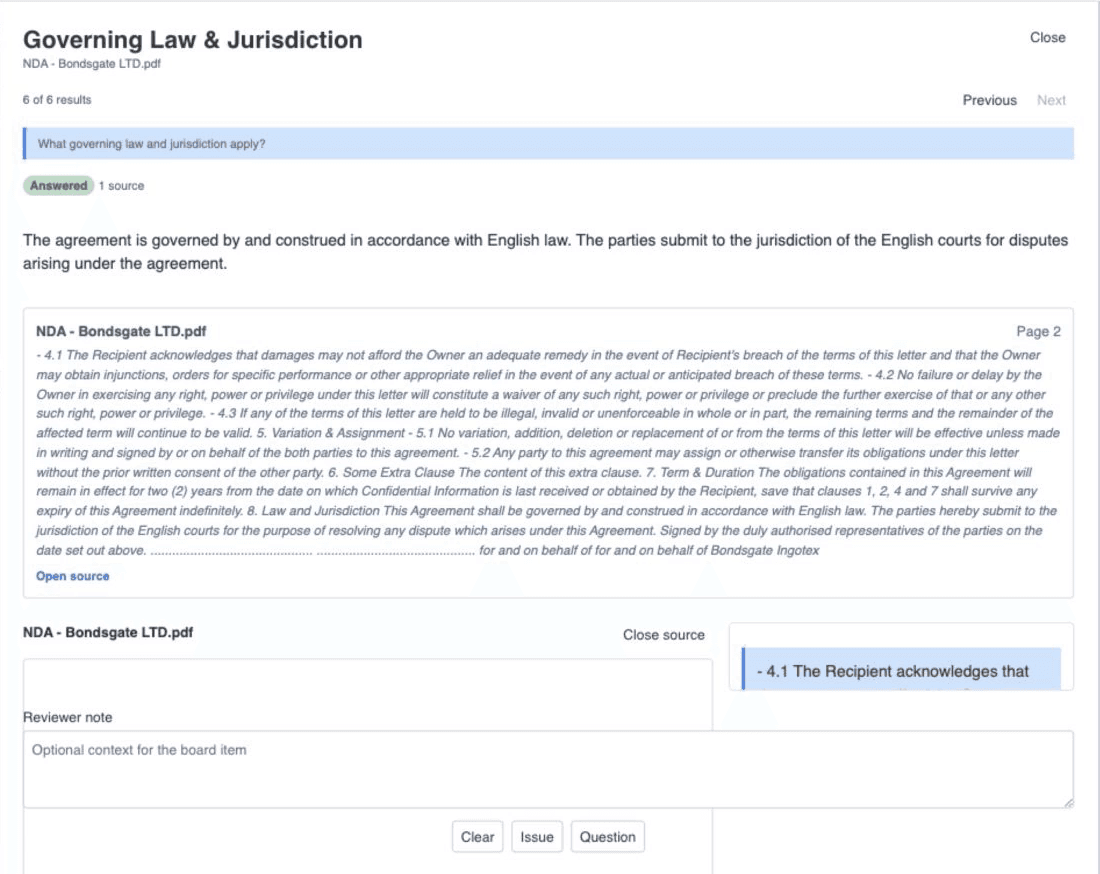
| Which law governs, and where are disputes resolved? | Governing law and the forum or arbitration seat. | Clear in most cases; Question for an unexpected jurisdiction. |
| Does the agreement include personal data processing terms? | Whether a DPA or data clause exists, and which party is controller or processor. | Issue when personal data is processed with no data terms at all. |
Two rules that make the columns work. Ask for one fact per column, so the answers line up across contracts. And phrase the question so that "insufficient evidence" is a useful result: if a contract has no change-of-control clause, the cell should say so rather than guess.
Reading the table
Read down a column to find the outliers: the three contracts out of forty that need consent, the one with a termination-for-convenience right on thirty days. Read across a row to brief a single contract. Open any cell to see the quoted passage and the page it came from beside the answer.
From table to diligence report
Each cell carries a decision: Clear, Issue, or Question. When the review is done, publish the Issues and Questions to the board. Each becomes an item with the contract name and the citation attached, so the deal team can assign an owner, set a due date and track the follow-up next to everything else on the deal. The whole table exports to Excel for the report and the data room record.
When a contract is replaced with a signed version or a missing schedule arrives, rerun that Document alone. The rest of the table is untouched, and republishing updates the existing items instead of creating duplicates.
What it costs on a deal
One Review Unit is one contract through one review with up to 15 Questions. Forty contracts is forty units. The Deal plan carries 1,000 units a month for a live transaction, and the annual plans pool their units so a heavy month is covered. Full detail is on the pricing page. Every plan covers unlimited authorized users on the monday account, so the whole deal team can read the table.
Confidentiality
Data room documents reach Doclayer only when someone on the deal selects them. They are stored under your Organization, are not used to train AI models, and are deleted within ten days of uninstalling the app. The full description is on the security page.