NDA review question template
NDAs are the ideal first document for a tabular review. They are short, they arrive in batches, and every one of them has to answer the same dozen questions before anyone can send a data room link. Below are the twelve columns we would start with, what a good cited answer looks like in each, and the ones that will often come back as insufficient evidence because the clause simply is not there.
The twelve columns
| Question (column) | What a good cell holds | Usual decision |
|---|---|---|
| Is the agreement mutual or one-way, and which party is disclosing? | Mutual or unilateral, named parties, and the direction of disclosure. | Clear. Question if the recitals and the operative clause disagree. |
| How is Confidential Information defined? | The definition, whether marking is required, and whether oral disclosures are covered. | Issue when protection depends on marking and your side does not mark. |
| What is excluded from Confidential Information? | The standard exclusions: already known, independently developed, public, received from a third party, released with approval. | Clear when all five are present; Question when one is missing. |
| What is the permitted purpose? | The purpose clause, quoted. Whether use is limited to evaluating the transaction. | Issue when the purpose is broader than the deal, or narrower than what your team needs to do. |
| Who may receive the information, and on what conditions? | Employees, affiliates, advisers, financing sources; whether each must be bound in writing. | Issue when advisers or financing sources are excluded and the deal needs them. |
| What standard of care applies? | Reasonable care, same care as own information, or a stated minimum. | Clear unless the standard is undefined. |
| How long does the agreement last, and how long do the obligations survive? | Term of the agreement, survival period for confidentiality, and any perpetual carve-out for trade secrets. | Question when survival is perpetual for everything, or shorter than the deal timetable. |
| What happens to the information on request or at the end? | Return or destruction, the timing, the certification requirement, and any retention carve-out for backups or compliance. | Question when there is no retention carve-out and your systems cannot comply. |
| What must a party do if compelled to disclose by law or a court? | Notice obligation, cooperation, and the limit to what is legally required. | Clear when notice and minimum disclosure are both present. |
| Is there a residuals clause? | Whether information retained in unaided memory may be used, and any limits. | Issue on the disclosing side; usually Clear on the receiving side. Often insufficient evidence, which is the right result. |
| Are there non-solicitation, standstill or exclusivity obligations? | Any restriction beyond confidentiality, with scope and duration. | Issue when a restriction binds the wider group or outlasts the deal. |
| Which law governs, and what remedies are stated? | Governing law, forum, and whether injunctive relief is acknowledged. | Clear in most cases; Question for an unexpected jurisdiction. |
Twelve leaves room for three more, which is the per-review limit. Common additions: whether the NDA restricts contacting the target's customers or employees during diligence, whether it contains a no-obligation-to-proceed clause, and whether it permits disclosure to a specific named party such as a co-investor.
Why these questions are phrased this way
Each column asks for one fact, so the answers line up when you read down the column across twenty NDAs. "What is excluded from Confidential Information?" will produce a comparable list in every row; "Is the confidentiality clause acceptable?" would produce twenty opinions.
Several questions are written expecting the clause to be absent. Most NDAs have no residuals clause and no standstill. A cell that says insufficient evidence for those is doing its job: it tells the reviewer the agreement is silent, which for a residuals clause is usually the answer you wanted.
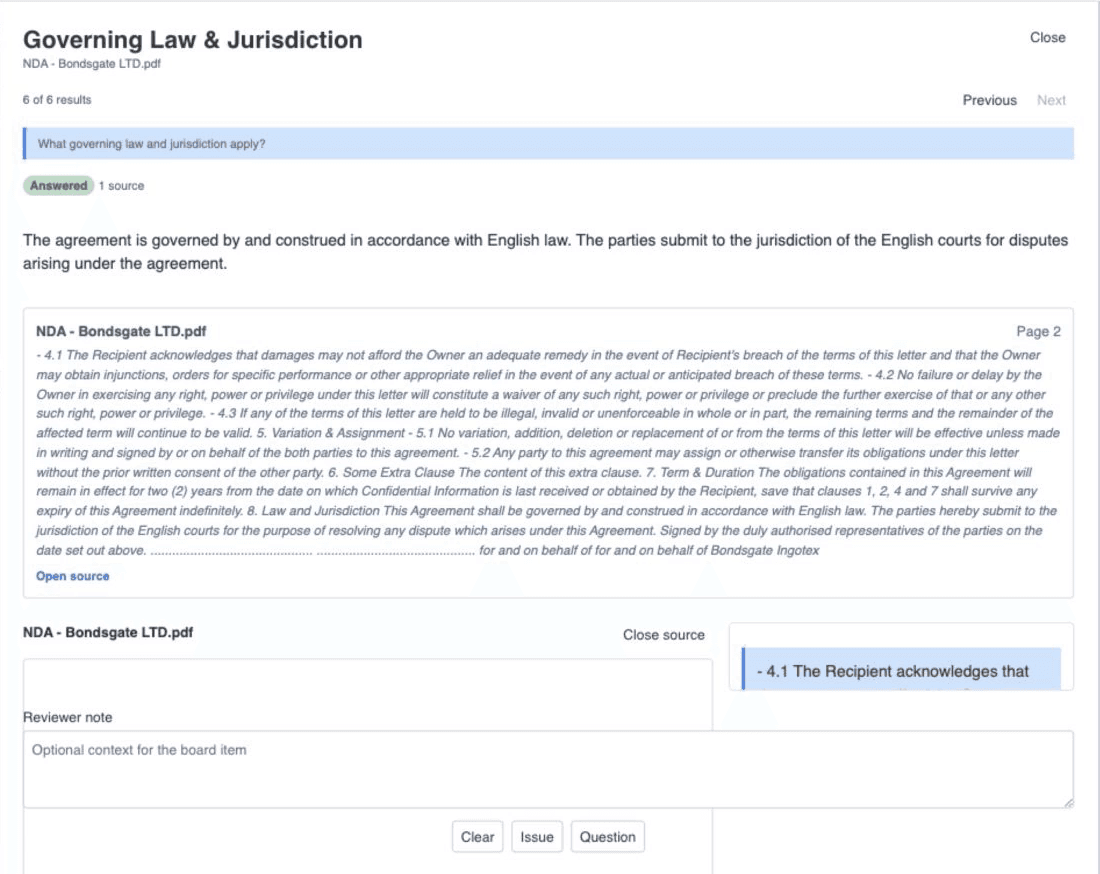
Running it in monday.com
- Attach the NDAs to items on the deal board, or have Doclayer upload them directly.
- Open the Doclayer Matrix view, select the NDAs, and add the twelve Questions above as columns. Paste them as written or adapt the wording to your house style.
- Run the review. Twenty NDAs is twenty Review Units; the free trial covers ten Documents.
- Read down the columns that matter for this deal first: permitted recipients, survival, and any restrictions beyond confidentiality. Open the citation on anything that looks off.
- Mark each cell Clear, Issue or Question, then publish the Issues to the board so the person negotiating the NDA owns them.
The next time a batch of NDAs arrives, the columns are already there. That is the quiet advantage of the table over a checklist: the checklist lives in a document, the table lives with the work.
A note on judgement
The "usual decision" column is a starting point, not advice. Whether a residuals clause is an Issue depends on which side you are on and what you are disclosing. The table gets the facts in front of the person making that call, with the evidence attached. The call is theirs.
Try it on your own NDAs, or see the M&A column set.